One Year of MAHA: Assessing the Strategy Report and Its Impact
Join CSPI on October 15th 3:00-4:00 PM ET for: "One Year of MAHA: Assessing the Strategy Report and Its Impact."
September marked one year since the Make America Healthy Again (MAHA) Commission released its strategy report outlining recommended actions to end childhood chronic disease in the United States. One year later, the administration is claiming victory, but have they really made progress?
Join us virtually for a discussion with staff from CSPI, STAT News, and the Union of Concerned Scientists as we analyze the administration’s impact on childhood chronic disease over the past year. We’ll review the administration’s progress on the MAHA Strategy Report’s recommendations, fact-check MAHA’s top “wins,” and provide an overall assessment of this administration’s impact on public health more broadly. We’ll share resources and tools you can use to stay informed about the administration’s actions and their impacts on public health and scientific integrity.
Register to attend here: https://us02web.zoom.us/webinar/register/WN_kp_jln8ySuWCb_3SoqdGZg
Speaker Information:
Isabella Cueto (she/her), Chronic Disease Reporter, STAT News | Isabella Cueto is a chronic disease reporter writing about how the Trump administration is tackling the nation’s health epidemic — or not. She’s taken readers inside the world of MAHA, behind the scenes in Washington, out to a regenerative farm in Texas, and back into the lab.
Jules Barbati-Dajches (they/them), Analyst, Union of Concerned Scientists |
Jules Barbati-Dajches is an analyst for the Center for Science and Democracy at the Union of Concerned Scientists. In their role, Dr. Barbati-Dajches conducts research and analyses to show the ways in which science and equity are politicized and the impacts of such politicization. Their research supports advocacy campaigns that show the necessity of protecting independent science to produce reliable data and evidence-informed policy. As one example, Jules led the development of UCS's Attacks on Science Tracker, an analytical platform that documents the second Trump administration's interference in federal science.
Anupama Joshi (she/her), Vice President of Programs, Center for Science in the Public Interest | Anupama Joshi leads CSPI’s program strategy on national, state, and local policy advocacy; legislative campaigns; and regulatory affairs to support equitable access to healthy, affordable, and sustainable food. She oversees projects on a wide range of issue areas such as school nutrition, healthy food access, food retail, food service guidelines, pouring rights, labeling, corporate engagement, food safety, additives, dietary supplements, and agricultural biotechnology.
Aviva Musicus (she/her), Science Director, Center for Science in the Public Interest | Aviva Musicus directs CSPI's Science Department. Her team helps to facilitate and strengthen transparency, use of best available science evidence, and rigorous scientific methods throughout CSPI's work. Prior to joining CSPI, Aviva was a Nutrition Postdoctoral Research Fellow at the Harvard Chan School of Public Health, where she is now an Adjunct Assistant Professor of Nutrition. She has conducted extensive research on food labeling, food marketing, federal assistance programs, and institutional procurement. Aviva holds a doctorate in Nutrition from the Harvard Chan School of Public Health and a Bachelor's degree in Environmental Studies from Yale University.
This event is hosted as a part of CSPI’s Resource Hub Training Series. We invite organizations and community advocates to join us, as we at CSPI learn alongside our partners and community at large to build power and share knowledge across disciplines on a myriad of social, economic, and environmental justice issues.
Este seminario virtual será en inglés y lo ofreceremos con interpretación y traducción al español en tiempo real.
Cross-Movement Collaboration: Putting the U.S. Just Food Transition Roadmap into Action
REGISTER HERE
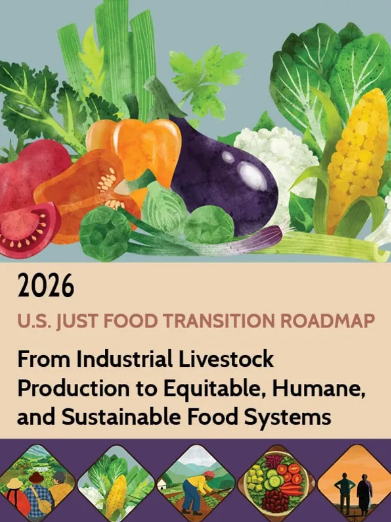
The webinar will introduce The U.S. Just Food Transition Roadmap, which provides a framework for collaboration across movements to build power and momentum across the nation for a just food transition. Produced in partnership with more than 20 labor, environmental, public health, animal welfare, agriculture, and food advocacy organizations, the roadmap outlines how we can work together to shift governments and public policy toward a food system that prioritizes people, animals, and the planet over corporate profits. This webinar will bring together a panel of representatives from each issue area – agriculture, environment, worker justice, animal welfare, and human health – to discuss how the roadmap can be implemented to achieve our shared vision. There will be opportunity for an audience Q&A.
Panelists:
Katie Gillespie, Farm Forward
Leah Kelly, Center for Biological Diversity
Magaly Licolli, Venceremos
Annette Manusevich, World Animal Protection
Becky Ramsing, Johns Hopkins Center for a Livable Future
SFDPH - Biennial Food Security & Equity Report - Community Engagement Meetings
The San Francisco Department of Public Health will be hosting two community engagement meetings for the second iteration of the Biennial Food Security & Equity Report, to be published early next year. We will be dedicating time to reviewing and analyzing data on food programs funded and implemented by City Departments, and to generate community-based recommendations focused on improving food security and health equity. Agendas will be sent out shortly before each meeting.
These meetings are open to the public; please forward this message to your networks. If you plan on attending, please RSVP through the Eventbrite links below so that we have an accurate headcount. We will be providing snacks and coffee/refreshments at both meetings.
Community Engagement Meeting #1 - RSVP here: https://www.eventbrite.com/e/1997926018504?aff=oddtdtcreator
Date: Tuesday, September 29
Time: 1pm - 4pm
Location: 25 Van Ness, Room 610
Community Engagement Meeting #2 - RSVP here: https://www.eventbrite.com/e/1997926858015?aff=oddtdtcreator
Date: Tuesday, October 27
Time: 1pm - 4pm
Location: Main Library, Latino/Hispanic Room
You can visit https://www.sf.gov/biennial-food-security-and-equity-report for the first report and all related resources.
Finding Your Future in Food Systems
Are you an emerging food systems professional? Are you in career transition, seeking a job in community food work?
This series is for you!
Finding Your Future in Food Systems provides participants with connections and insights to help them identify next steps for their careers.
The series includes speakers from a wide variety of sectors within the food systems profession: policy & advocacy, market development, food access initiatives, value chain development, education, and farming, both urban and rural.
The series features speakers from job-creating organizations, agencies, and businesses, some working locally in their communities, others with national and international scope. Produced by college students for college students and other emerging professionals.
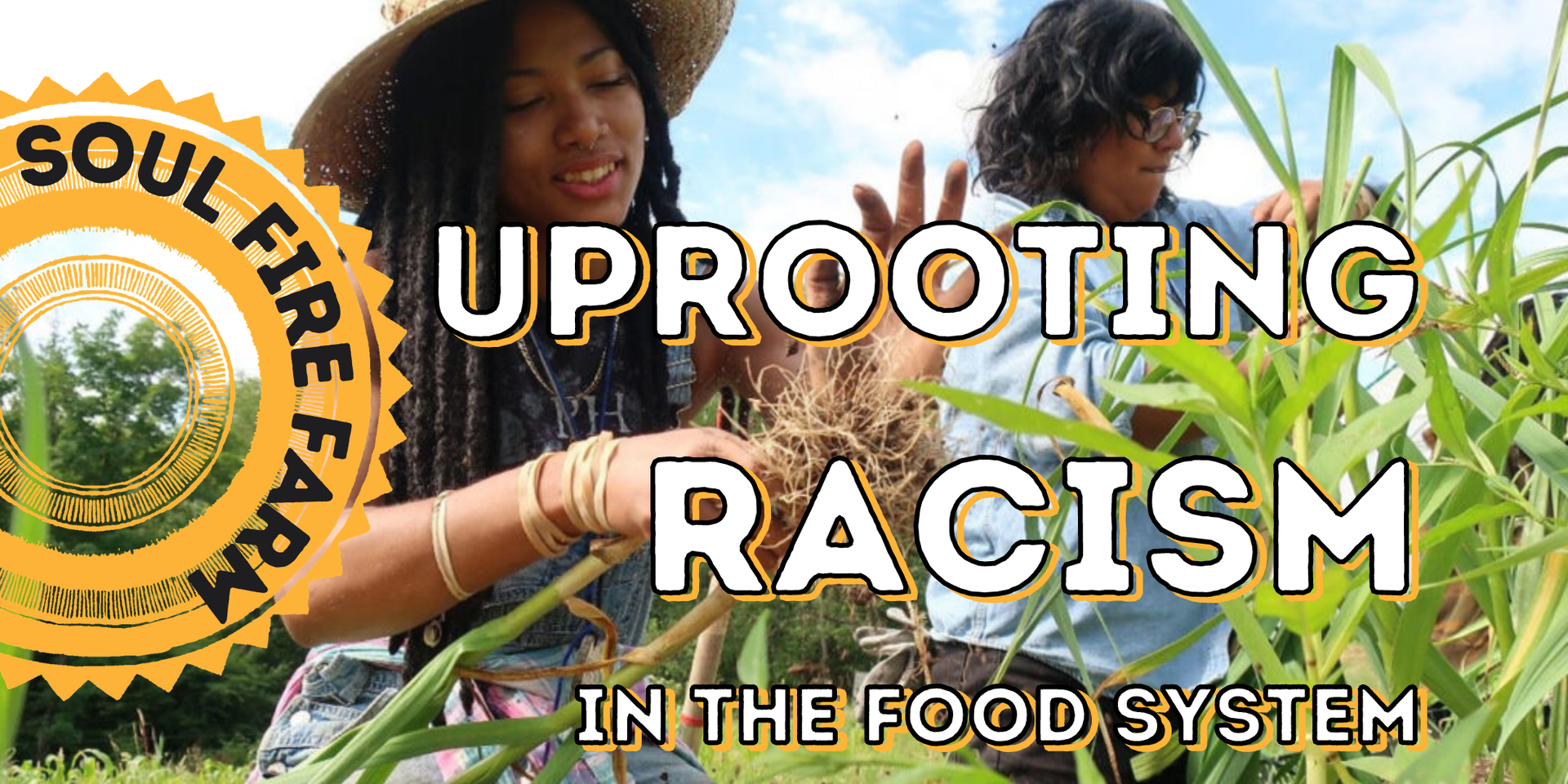
Uprooting Racism Training (URFS)
The Uprooting Racism training is a theory and action workshop for environmental and food justice leaders to uproot systemic racism in our organizations and society. We delve deep into the history and structural realities of racial injustice and develop an understanding of the movement strategies of frontlines communities struggling for food sovereignty. We will examine our personal and societal roles of complicity in and resistance to the system. Much of the time will be spent developing tangible action plans – to use our sphere of influence to uproot these oppressions. True to Soul Fire Farm’s values and culture, this work will be rooted in fierce love, courageous self-reflection, and healing connection to land.
Uprooting Racism Training (URFS)
The Uprooting Racism training is a theory and action workshop for environmental and food justice leaders to uproot systemic racism in our organizations and society. We delve deep into the history and structural realities of racial injustice and develop an understanding of the movement strategies of frontlines communities struggling for food sovereignty. We will examine our personal and societal roles of complicity in and resistance to the system. Much of the time will be spent developing tangible action plans – to use our sphere of influence to uproot these oppressions. True to Soul Fire Farm’s values and culture, this work will be rooted in fierce love, courageous self-reflection, and healing connection to land.
Co-Creating the Future of Food: How Food Policy Councils Can Drive Inclusive Planning
Co-hosted by the Statewide and Regional Food System Plans National Community of Practice and Food Policy Networks, this November session will explore how how food policy councils can drive inclusive planning.
In this session, we will learn strategies for how Food Policy Councils can develop, support, implement, and evaluate the implementation of local food plans while increasing civic engagement and community well-being.
Guest speaker:
Nessa Richman, Executive Director of the Rhode Island Food Policy Council and author of Food Policy Councils: Building Civic Engagement and Community Well-Being (Routledge 2026).
Guest host:
Marissa Baron, Network Director, Food Policy Networks
Who should attend?
NCoP members and food systems stakeholders interested in food systems planning
Food (policy) council members
Coordinated by the Michigan State University Center for Regional Food Systems, the Statewide and Regional Food Systems Plans National Community of Practice (NCoP) is a national, multi-state space that convenes leaders from current and emerging food system plan efforts across the country to increase our collective knowledge and capacity to collaborate and strengthen local and regional food systems using an equity approach.
Find more resources and tools on the NCoP website.
Finding Your Future in Food Systems
Are you an emerging food systems professional? Are you in career transition, seeking a job in community food work?
This series is for you!
Finding Your Future in Food Systems provides participants with connections and insights to help them identify next steps for their careers.
The series includes speakers from a wide variety of sectors within the food systems profession: policy & advocacy, market development, food access initiatives, value chain development, education, and farming, both urban and rural.
The series features speakers from job-creating organizations, agencies, and businesses, some working locally in their communities, others with national and international scope. Produced by college students for college students and other emerging professionals.
Using a Right to Food Election Guide
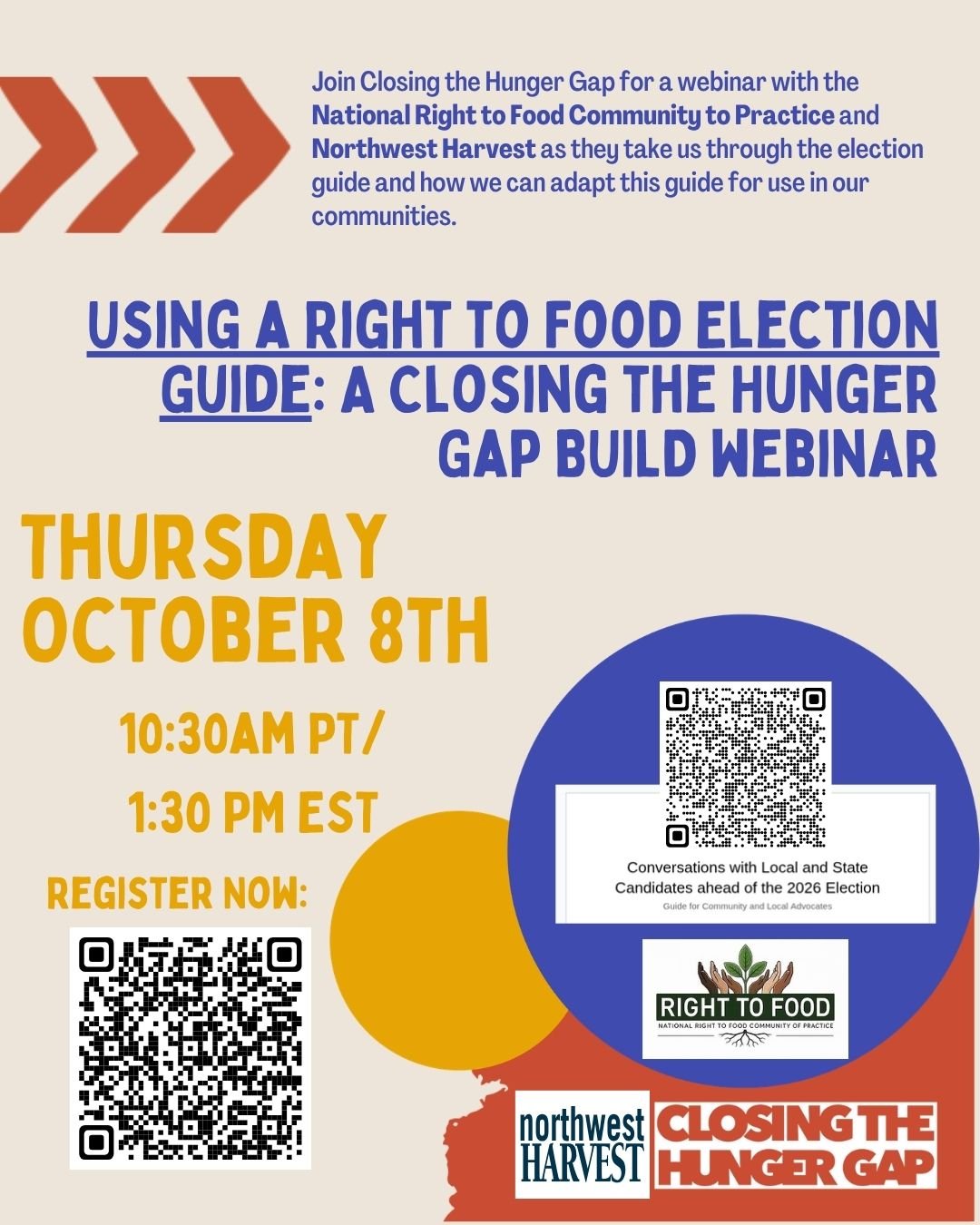
Using a Right to Food Election Guide: A Closing the Hunger Gap BUILD Webinar
A strong democracy is an essential element to ensuring the right to food. This includes BUILDing relationships with elected officials and holding them accountable to their part in ensuring an equitable food system for everyone.
The National Right to Food Community of Practice has created an election guide to help community and local advocates talk to local and state candidates about how they will use their role in office to promote a food system that nourishes people and the planet. These guides are for anyone who believes food is a human right and wants to elect politicians in their local area who believe that as well.
Join Closing the Hunger Gap for a webinar with the National Right to Food Community to Practice and Northwest Harvest as they take us through the election guide and how we can adapt this guide for use in our communities.
Thursday, October 8, 2026 | 10:30 AM-12:00 PM PT/ 1:30-3:00 PM EST
Virtual Event | Zoom
Register now: Meeting Registration - Zoom
Public Charge 101 for Trusted Messengers
WEBINAR on 10/8: Public Charge 101 for Trusted Messengers
Interpretación en español disponible: Este seminario web contará con interpretación simultánea en vivo al español.
We invite you to join us on Thursday, October 8th, at 12:00 PM PT for a webinar designed to help Trusted Messengers better understand Public Charge and recent changes that may affect the communities they serve. This session will bring together state, legal, and community experts to share updates, address common questions, and highlight trusted resources and approaches that Trusted Messengers can use in their work.
Why should Trusted Messengers attend?
Increase your understanding of Public Charge and recent changes that may affect the communities you serve.
Strengthen your ability to communicate clear and accurate Public Charge information to patients, clients, and community members.
Become familiar with trusted Public Charge resources, ask questions, seek clarification, and share resources with others.
Who Should Attend?
Community Health Workers, Promotoras, and Representatives (CHW/P/Rs)
Trusted Messengers
Coverage Ambassadors
Benefits Navigators and Enrollment Assisters
Community-Based Organizations and other community-facing partners supporting individuals and families with health coverage, public benefits, and related services
Guest Speakers: Featuring experts in immigration law, public benefits, and community resources, including:
Yannina Casillas, JD, Innovation and Equity Unit Manager, California Department of Social Services
Erin Quinn, JD, Senior Managing Attorney, Immigrant Legal Resource Center
Trusted Messenger Spotlight Speaker: To be announced soon
Moderators:
Joe Lee, MSHA, Founder & Principal Consultant, Community Health Synergy
Rhodora Ursua, MPH, Principal Consultant, Community Health Synergy
Certificates of completion will be available for webinar attendees. More details on how to receive a certificate will be shared with registrants soon.
This webinar is hosted by Community Health Synergy and sponsored by the California Health and Human Services Agency and The California Endowment.
For questions, please contact training@communityhealthsynergy.com.
Accessibility Accommodations: If you need any accommodations to participate in this virtual webinar, please let us know at least 3 days in advance so we can make appropriate arrangements.
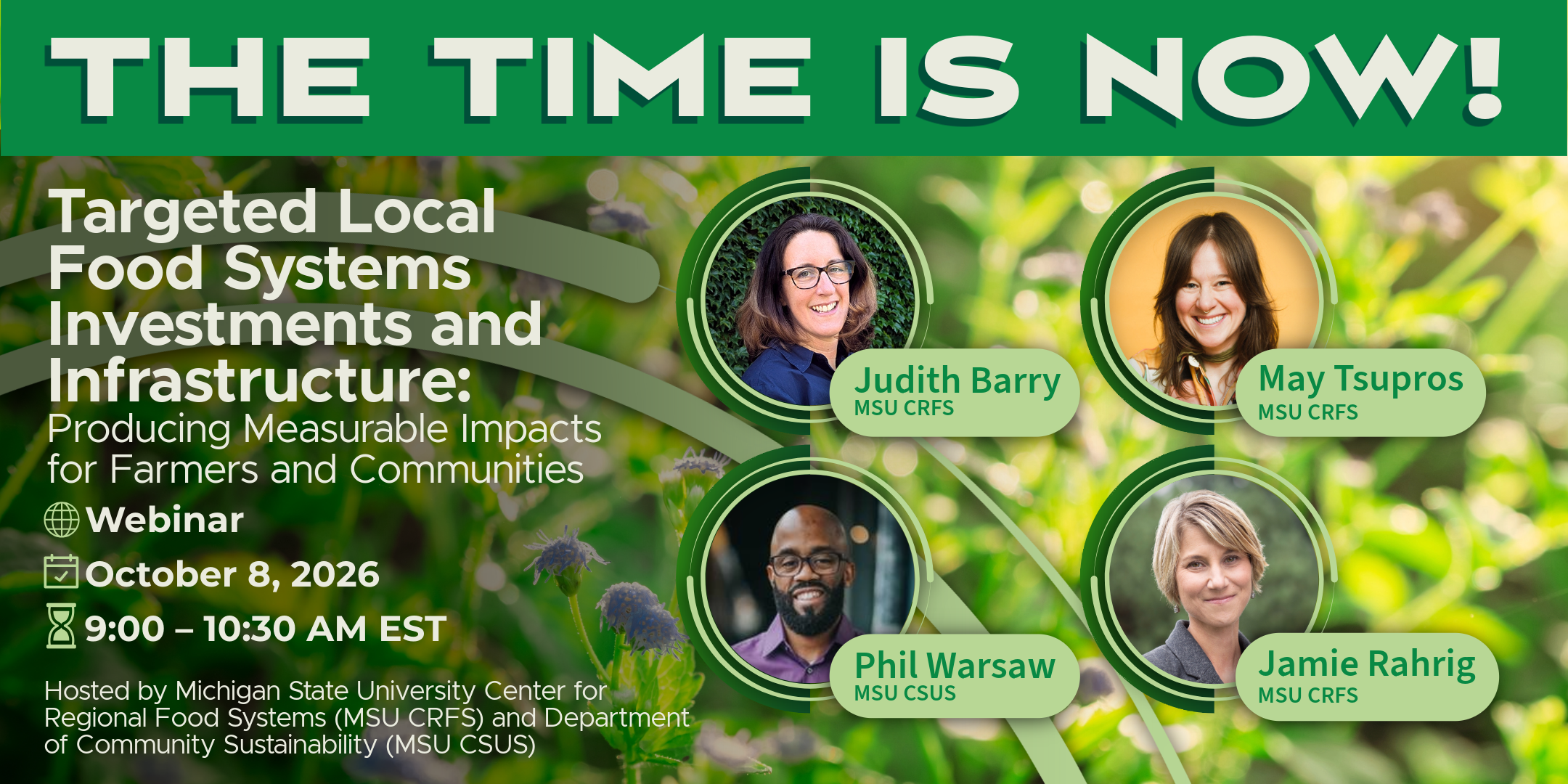
Targeted Local Food Systems Investments and Infrastructure: Producing Measurable Impacts for Farmers and Communities
Investments in local food purchasing infrastructure by the federal and state government have generated significant returns over the last five years, increasing capacity for local food purchasing and stimulating impacts for producers and consumers. These efforts have highlighted the continued need for targeted funding sources to ensure the resilience to shocks to the food system and support for the maintenance of the gains that were made during the last half decade.
Michigan State University Center for Regional Food Systems (CRFS) invites food systems leaders, policy and funding decision makers, and state agency leaders, and partners to attend this 90-minute webinar highlighting the implications of the findings from the National Food Hub Survey, Local Food Purchase Assistance Cooperative Agreement Program (U.S. and Michigan), and 10 Cents a Meal for Michigan’s Kids and Farms.
Speakers:
Judith Barry, Associate Director, CRFS
May Tsupros, Director of Farm to Institution Programs, CRFS
Dr. Phil Warsaw, Assistant Professor, MSU Department of Community Sustainability
Jamie Rahrig, Director of Food and Farm Business Assistance, CRFS
35th Annual Hoes Down Harvest Festival
Hoes Down Harvest Festival
Saturday,October 3rd, 2026
Full Belly Farm
The Hoes Down Harvest Festival is dedicated to honoring and promoting the knowledge of agricultural arts and sustainable rural living through inspiration and education. For over 30 years, the Hoes Down has generated valuable resources for local and statewide organizations working on projects which benefit sustainable agriculture and rural communities.
Invitation for Impact - How to Host Site Visits with Policymakers (A Good Food for Michigan Workshop)
We know that when institutions buy and serve local foods, they support local producers, strengthen the economy, and promote healthy eating.
Site visits are an impactful way to help decision-makers better understand your efforts and how their decisions can help support it—whether your goal is to raise awareness, show progress, or advocate for change.
In this 60-minute, interactive workshop, participants will walk through the steps to planning and hosting a site visit with policymakers. You will have a chance to test out an approach for identifying your goals, designing the experience.
This workshop is accompanied by the Good Food for Michigan written guide: "Invitation for Impact: How To Host Policymaker Site Visits."
This workshop is free, but registration is required.
To learn more about Good Food for Michigan, please visit: https://goodfoodpurchasing.org/good-food-for-michigan/
SFDPH - Biennial Food Security & Equity Report - Community Engagement Meetings
The San Francisco Department of Public Health will be hosting two community engagement meetings for the second iteration of the Biennial Food Security & Equity Report, to be published early next year. We will be dedicating time to reviewing and analyzing data on food programs funded and implemented by City Departments, and to generate community-based recommendations focused on improving food security and health equity. Agendas will be sent out shortly before each meeting.
These meetings are open to the public; please forward this message to your networks. If you plan on attending, please RSVP through the Eventbrite links below so that we have an accurate headcount. We will be providing snacks and coffee/refreshments at both meetings.
Community Engagement Meeting #1 - RSVP here: https://www.eventbrite.com/e/1997926018504?aff=oddtdtcreator
Date: Tuesday, September 29
Time: 1pm - 4pm
Location: 25 Van Ness, Room 610
Community Engagement Meeting #2 - RSVP here: https://www.eventbrite.com/e/1997926858015?aff=oddtdtcreator
Date: Tuesday, October 27
Time: 1pm - 4pm
Location: Main Library, Latino/Hispanic Room
You can visit https://www.sf.gov/biennial-food-security-and-equity-report for the first report and all related resources.

A Slice of Our Markets
About This Event
Join us for an unforgettable evening celebrating the people, flavors, and community that make our Berkeley Farmers' Markets thrive.
Slice of our Markets begins with an exclusive guided tour of the North Berkeley Farmers' Market, led by Ecology Center staff. Meet the farmers behind your food and gain a deeper appreciation for the sustainable practices that nourish our communities and strengthen connections between local farms and the people they feed.
Following the tour, gather at Vintage Berkeley for a farm-to-table experience featuring artisan pizzas and seasonal bites prepared with peak-season ingredients sourced directly from the Berkeley Farmers' Market. Enjoy local wine, beer, and seasonal accompaniment pairings as you connect with fellow supporters who share a passion for healthy food, thriving communities, and environmental stewardship.
Your Ticket Includes
Guided North Berkeley Farmers' Market tour
Farm-to-table artisan pizza dinner and seasonal accompaniments
Wine, beer, and non-alcoholic beverages
Opportunities to meet local farmers and community members
The chance to support the Ecology Center's Food & Farming program
Why Attend?
More than a memorable evening, Slice of our Markets is a fundraiser focused on the Ecology Center's Food & Farming program. Every ticket purchased helps sustain and strengthen the work behind our farmers' markets, expand access to fresh, healthy food through programs like Market Match, and support our leadership in convening the California Alliance of Farmers' Markets, where we help strengthen farmers' markets across the state.
Your support helps build a more resilient, equitable, and thriving food system while investing in local farmers, healthy communities, and a sustainable future.
We look forward to celebrating with you!
Food Justice is Racial Justice – Level 1 Racial Equity Workshop
The Collective on Racial Equity (CORE) invites food system practitioners, farmers, organizers, educators, and community leaders to join a two-day virtual workshop exploring racial equity in the food system.
This Level 1 training provides an entry point for people who want to deepen their understanding of how race, power, and history shape food systems in the United States and beyond. Participants will explore how inequities show up across land, labor, access, policy, and culture while building relationships with others committed to transforming the food system. The September session is the last session of the FJRJ Workshop for 2026.
This workshop is hosted by the Collective on Racial Equity (CORE) in partnership with the Food Systems Leadership Network.
This workshop is hosted at no cost to participants – but registration is required as space is limited.
Register HERE
Dates
September 22nd | 10:00 AM – 4:00 PM
September 23rd | 10:00 AM – 3:00 PM
This workshop includes
Somatic grounding and reflection practices
Small group dialogue and storytelling
Exploration of historical and contemporary examples
Interactive activities connecting race to food systems
Opportunities to consider personal and organizational action
This training is intended for people who are ready to engage honestly, listen deeply, and learn in community with others. No previous racial equity training is required.
This workshop is designed for
Food system practitioners
Farmers and/or farm workers
Nonprofit and community organization staff
Institutional partners
Funders and policy advocates
Anyone interested in understanding the connections between race and food systems
The training serves as an entry point into racial equity work within food systems.
What participants can expect
Guided grounding and somatic practices
Exploration of the history of race and racism in the United States and its relationship to food and land
Interactive activities that connect personal experience with systemic analysis
Discussion of labor, land, migration, and food access
Collaborative reflection with others working across the food system
Opportunities to envision new practices rooted in racial and food justice
The workshop centers experiential learning and encourages participants to reflect on their own roles within food systems and within movements for justice.
Celebrating Womxn's Leadership in Food 10th Annual Symposium
A day of education, celebration and connection in Sebastopol
Join us for our TENTH annual symposium in Sebastopol, CA - a day to celebrate, learn, and connect with others under the September sun! We will reflect on the collective work we've all done to cultivate food justice and move towards food sovereignty, while growing ourselves and our communities in the process. There will be time to dive deep in conversation, enjoy amazing food, join in afternoon workshops, explore the art exhibit, and dance together. Help us envision what the next ten years will bring!
Some special things to note this year:
You can use an add-on when purchasing your ticket to reserve a camping spot for Saturday night! Limited space available.
Let us know if you want to volunteer (in exchange for a ticket!) by filling out this form.
If a scholarship would support your attendance, apply here.
Tickets are offered with tiered pricing - select what works best for you.
Agenda
9:00 - 9:30 AM - Arrival, Coffee, Snacks
9:30 - 10 AM - Welcome + Opening Session Introduction
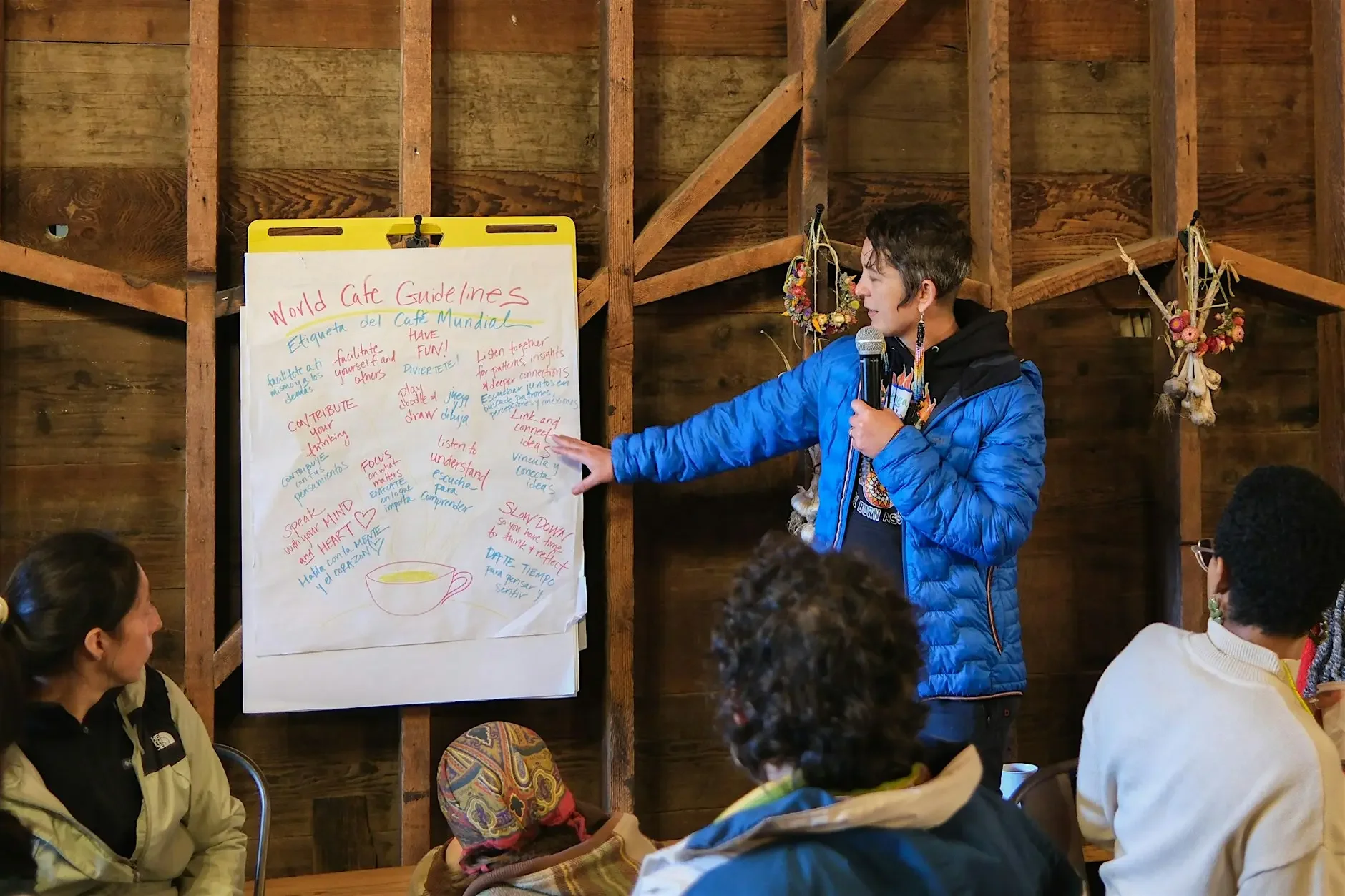
10:00 AM - 1:00 PM - World Cafe with Special Speakers
1:00 - 2:15 PM - Lunch (GF, DF, V options)
2:15 - 2:30 - Workshop Introductions
2:30 - 4 - Workshops
Cheese Making with Aubrie Maze
Movements are Gardens with Wanda Stewart
Flower Crown Making with Hedda Brorstrom
Indigenous Food as Medicine with Amythest Faria
Herbs for Community Care with Stephanie Maldanado/ Apothecary for the People
4:00 - 4:45 PM - Circle Up, Pinata, Closing Remarks + Gratitude
4:45 - 6 PM - Mocktail Hour, Music + Dancing
REGISTER HERE!
Celebrating Womxn's Leadership in Food 10th Annual Symposium
Join us for our TENTH annual symposium in Sebastopol, CA - a day to celebrate, learn, and connect with others under the September sun! We will reflect on the collective work we've all done to cultivate food justice and move towards food sovereignty, while growing ourselves and our communities in the process. There will be time to dive deep in conversation, enjoy amazing food, join in afternoon workshops, explore the art exhibit, and dance together. Help us envision what the next ten years will bring!
Some special things to note this year:
You can use an add-on when purchasing your ticket to reserve a camping spot for Saturday night! Limited space available.
Let us know if you want to volunteer (in exchange for a ticket!) by filling out this form.
If a scholarship would support your attendance, apply here.
Tickets are offered with tiered pricing - select what works best for you.
Agenda
9:00 - 9:30 AM - Arrival, Coffee, Snacks
9:30 - 10 AM - Welcome + Opening Session Introduction
10:00 AM - 1:00 PM - World Cafe with Special Speakers
1:00 - 2:15 PM - Lunch (GF, DF, V options)
2:15 - 2:30 - Workshop Introductions
2:30 - 4 - Workshops
Cheese Making with Aubrie Maze
Movements are Gardens with Wanda Stewart
Flower Crown Making with Hedda Brorstrom
Indigenous Food as Medicine with Amythest Faria
Herbs for Community Care with Stephanie Maldanado/ Apothecary for the People
4:00 - 4:45 PM - Circle Up, Pinata, Closing Remarks + Gratitude
4:45 - 6 PM - Mocktail Hour, Music + Dancing
REGISTER HERE
Seed Celebration: Saving Seeds With Song, Story, and Dance
Seed Celebration: Saving Seeds With Song, Story, and Dance
September 19 | 2–7 PM
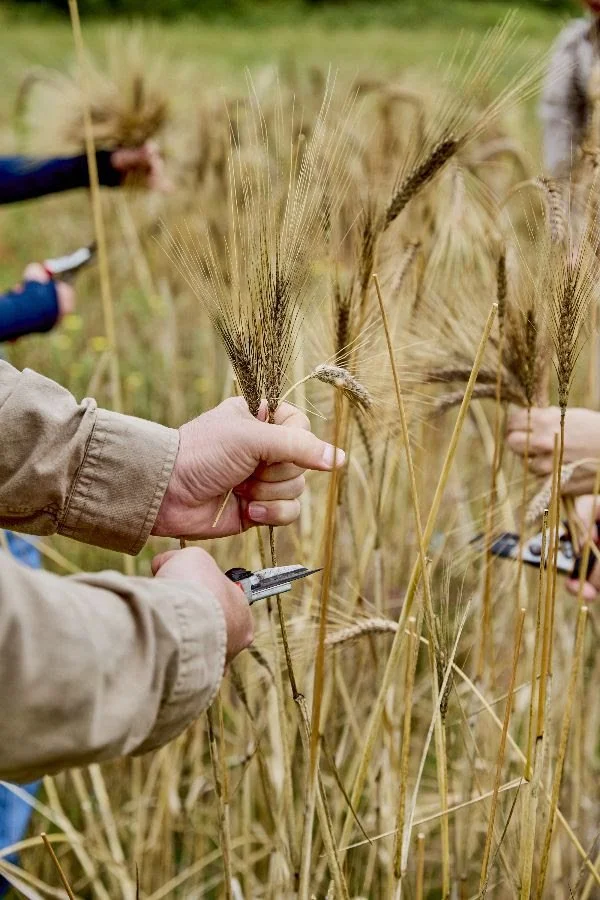
Over the past month, Farmer Mai has been leading intimate harvest gatherings in the heirloom grain fields. Together, participants have harvested rare grain varieties by hand, sharing stories and reconnecting with the rhythms of seed stewardship.
These gatherings have remained intentionally small. As a member of this community, you are among the few invited to experience this rare tradition where preserving biodiversity, culture, and community become one practice.
This harvest carries a story. Last winter, many of us danced in these same fields as part of the Earthseed journey, offering our footsteps, songs, and joy as a blessing to the seeds resting beneath the soil. Across generations and continents, communities have gathered to sing, dance, and celebrate the cycles of cultivation. Now, we return to harvest the grains whose beginnings we honored together.
This season culminates with our Seed Celebration on September 19, a day devoted to saving seeds and celebrating the relationships that allow them to continue. From 2–5 PM, we will gather under the shade of willows to clean and save seed, share stories, and honor the heirloom grains entrusted to us. From 5–7 PM, we will celebrate summer’s abundance with food, music, dance, and the joy of being together in the field.
Come help carry these seeds forward.
To participate in August harvest gatherings, please message Mai at mai@farmermai.com. RSVP for the Seed Celebration here.
This celebration also opens into the 10th anniversary of the Celebrating Womxn’s Leadership in Food Symposium on September 20, continuing our shared celebration of the people, knowledge, and relationships that nourish a more resilient food future.
Free Healthy School Meals for All: Nourishing Kids and Supporting Affordability for Families
Free Healthy School Meals for All: Nourishing Kids and
Supporting Affordability for Families
As a new school year begins, families across the country are struggling to keep up with the rising cost of groceries, gas, housing, child care, and health care. Research shows that school meals are the healthiest source of food for children, and public opinion polling shows that the majority of voters support offering school meals at no charge to families.
Learn more about the National Healthy School Meals for All Coalition
Providing every student with a healthy school breakfast and lunch at no charge helps families stretch every paycheck, ensures children are hunger free and ready to learn, and reduces administrative work so school nutrition professionals have more time to prepare fresh and appealing meals.
The nine states that offer free school meals for all and the thousands of schools across the country that offer school meals at no charge through the Community Eligibility Provision are demonstrating that Healthy School Meals for All works for students, families, schools, and farmers. Now it's time for Congress to build on and protect that success by passing legislation to ensure every child, in every community, has access to free healthy school meals.
Learning Across Food Systems Plans: A Landscape of Approaches to Inform Food Systems Planning and Implementation Practice
Hosted by the Statewide and Regional Food System Plans National Community of Practice, this September Connection Session will focus on exploring what other food systems planning efforts can teach us.
What can other food systems planning efforts teach us about our own planning and implementation efforts?
Drawing on interviews with leaders of 17 food systems planning efforts across the United States, guest speakers Lia Kelinsky-Jones and Shadrack Nii Yarboi Yartey from Virginia Tech will share lessons from recent efforts on how plans get started, stakeholders are engaged, and what helps or hinders implementation over time.
Following a brief presentation, attendees will engage in facilitated peer-to-peer coaching to reflect on their planning efforts, identify implementation challenges, and exchange practical strategies to strengthen food systems planning in their communities. Attendees will leave with actionable ideas and new connections to support their work.
Guest speakers:
Lia Kelinsky-Jones, Research Assistant Professor, Agricultural, Leadership, and Community Education and Assistant Director for Research, Center for Food Systems and Community Transformation at Virginia Tech
Shadrack Nii Yarboi Yartey, Graduate Research Assistant, Virginia Tech
Who should attend?
NCoP members and food systems stakeholders interested in learning about approaches to food systems planning
Coordinated by the Michigan State University Center for Regional Food Systems, the Statewide and Regional Food System Plans National Community of Practice, is a national, multi-state space that convenes leaders from current and emerging food system plan efforts across the country to increase our collective knowledge and capacity to collaborate and strengthen local and regional food systems using an equity approach.
Find more resources and tools on the NCoP website.
What Should a Comprehensive, Equitable Farm Bill Look Like?
What Should a Comprehensive, Equitable Farm Bill Look Like?
Tuesday, September 8, 2026, 3:00 p.m. Eastern (2:00 p.m. Central, 1:00 p.m. Mountain, 12:00 p.m. Pacific)
Congress has returned to Washington with major decisions ahead on the Farm Bill and the future of the Supplemental Nutrition Assistance Program (SNAP).
A few weeks ago, the Senate Agriculture Committee failed to advance Chairman John Boozman’s Farm Bill 2.0 proposal. The debate highlighted deep disagreements over SNAP, particularly the unprecedented costs H.R. 1 shifts to states. But the future of SNAP cannot be reduced to a debate over whether states receive one or two additional years to implement harmful federal cuts.
Join us for a timely discussion about what a comprehensive and equitable Farm Bill should accomplish.
We will also look beyond the current negotiations to discuss what Congress would need to do to rebuild and strengthen SNAP, recognizing that SNAP needed reform long before H.R. 1 became law.
For decades, federal policies have created barriers that limit who can participate, how much assistance families receive, and whether the program responds adequately to hunger and economic hardship. Puerto Rico remains excluded from SNAP and instead operates under a capped block grant. College students face additional eligibility restrictions. Federal law continues to impose restrictions affecting certain people with felony convictions. The shelter deduction does not fully recognize housing costs for many households. Immigration restrictions have long excluded some lawfully present immigrants. And questions about benefit adequacy and the Thrifty Food Plan persist.
This Farm Bill debate provides an opportunity to ask a much larger question: If we were designing SNAP to effectively prevent hunger, reduce inequities, and serve eligible families today, what would we change?
Cohort 4 California Farm to School Incubator Grant Program - Info Session #2 (English)
Please join the CDFA Office of Farm to Fork (CDFA-F2F) for a virtual info session about the Cohort 4 California Farm to School Incubator Grant Program.
During this session, CDFA-F2F will provide an overview of the draft Request for Applications (RFA) and allow time for questions and public comments. Please note CDFA-F2F is also welcoming written comments about the draft RFA until 5pm PT on September 11, 2026.
Please submit written comments via the public comment submission link, found on the CDFA Farm to School grant webpage (https://www.cdfa.ca.gov/caf2sgrant/).
Once the public comment period is complete, CDFA will incorporate stakeholder feedback in the final RFA and the grant application period will begin in October 2026.
Cohort 4 California Farm to School Incubator Grant Program - Info Session #2 (SPANISH)
Sesión Informativa Virtual por Zoom sobre el Módulo 4 del Programa de Subvenciones para Incubadoras del Campo a la Escuela de California
Miércoles 2 de septiembre de 2026, 1PM-2PM, PST
Acompañe a la Oficina del Campo a la Mesa (CDFA F2F) del Departamento de Alimentos y Agricultura de California a una sesión informativa virtual sobre el Módulo 4 del Programa de Subvenciones para Incubadoras del Campo a la Escuela de California. Durante esta sesión, el CDFA F2F dará un resumen del borrador de la Convocatoria de Solicitudes (Request For Applications, RFA en inglés) del Programa, y abrirá el espacio para recibir preguntas y comentarios públicos.
Por favor tome en cuenta que la Oficina del CDFA F2F también estará recibiendo comentarios por escrito sobre el borrador del RFA hasta las 5pm, PST del día 11 de septiembre, de 2026. Por favor haga sus comentarios por escrito a través del siguiente enlace que se encuentra en la página web del Programa de Subvenciones del Campo a la Escuela (https://www.cdfa.ca.gov/caf2sgrant/).
Una vez terminado el periodo para hacer comentarios públicos, el CDFA incorporará los comentarios de los interesados en la versión final del RFA y el periodo para presentar solicitudes al programa de subvenciones comenzará en octubre de 2026.
---
NOTE: This Info Session is Spanish Only and English translation will not be provided

CA Farm to School Network Monthly Call - August
Join CDFA and CDE for August CA Farm to School Network Monthly Call
Thursday, August 27, 2026, from 2-3 PM via Zoom
Co-hosted by the California Department of Food and Agriculture (CDFA) and the California Department of Education (CDE), the CA Farm to School Network Monthly Calls are open to the public + gather together school nutrition professionals, educators, gardeners, farmers, food hubs, and support organizations to grow the farm to school movement.
Join Thursday, August 27, to learn from your peers, share best practices, and identify funding opportunities to support your farm to school programs.
Click here to register!
Mississippi Story of Relationships, Culture, and Planning Food Futures
Hosted by the Statewide and Regional Food System Plans National Community of Practice, this August Connection Session will focus on fostering deep cultural engagement in communities.
Mississippi has existed as a state for just over 200 years, within the broader 250-year history of the United States. During this time, the state’s people, land, water, and culture have been profoundly shaped by leadership, policy, and funding practices. In response, The Center for Mississippi Food Systems has been leading a statewide initiative to develop a food plan that brings the entire ecosystem into meaningful conversation with communities and their leaders.
This work is grounded in a multi-year commitment to building right relationships and fostering deep cultural engagement.
Guest speakers:
Noel Didla, The Center for Mississippi Food Systems
Liz Broussard Red, The Center for Mississippi Food Systems
Alex Lawson, The Center for Mississippi Food Systems
In their words, "During this session, we will:
Bear witness to our statewide efforts alongside a national community of practice;
Share core practices that ground our movement; and
Outline our current timeline for driving systemic change.
Our intention is to:
Publicly document our journey;
Integrate our work into the national policy and planning landscape;
Be part of feedback loops that foster collaboration, growth, and refinement; and
Gain actionable insights into advocacy, coalition-building, governance, and infrastructure."
Who should attend?
NCoP members and food systems stakeholders interested in learning about approaches to food systems planning
Coordinated by the Michigan State University Center for Regional Food Systems, the Statewide and Regional Food System Plans National Community of Practice, is a national, multi-state space that convenes leaders from current and emerging food system plan efforts across the country to increase our collective knowledge and capacity to collaborate and strengthen local and regional food systems using an equity approach.
Find more resources and tools on the NCoP website.
Cohort 4 California Farm to School Incubator Grant Program - Info Session #2 (English)
Please join the CDFA Office of Farm to Fork (CDFA-F2F) for a virtual info session about the Cohort 4 California Farm to School Incubator Grant Program.
During this session, CDFA-F2F will provide an overview of the draft Request for Applications (RFA) and allow time for questions and public comments. Please note CDFA-F2F is also welcoming written comments about the draft RFA until 5pm PT on September 11, 2026.
Please submit written comments via the public comment submission link, found on the CDFA Farm to School grant webpage (https://www.cdfa.ca.gov/caf2sgrant/).
Once the public comment period is complete, CDFA will incorporate stakeholder feedback in the final RFA and the grant application period will begin in October 2026.
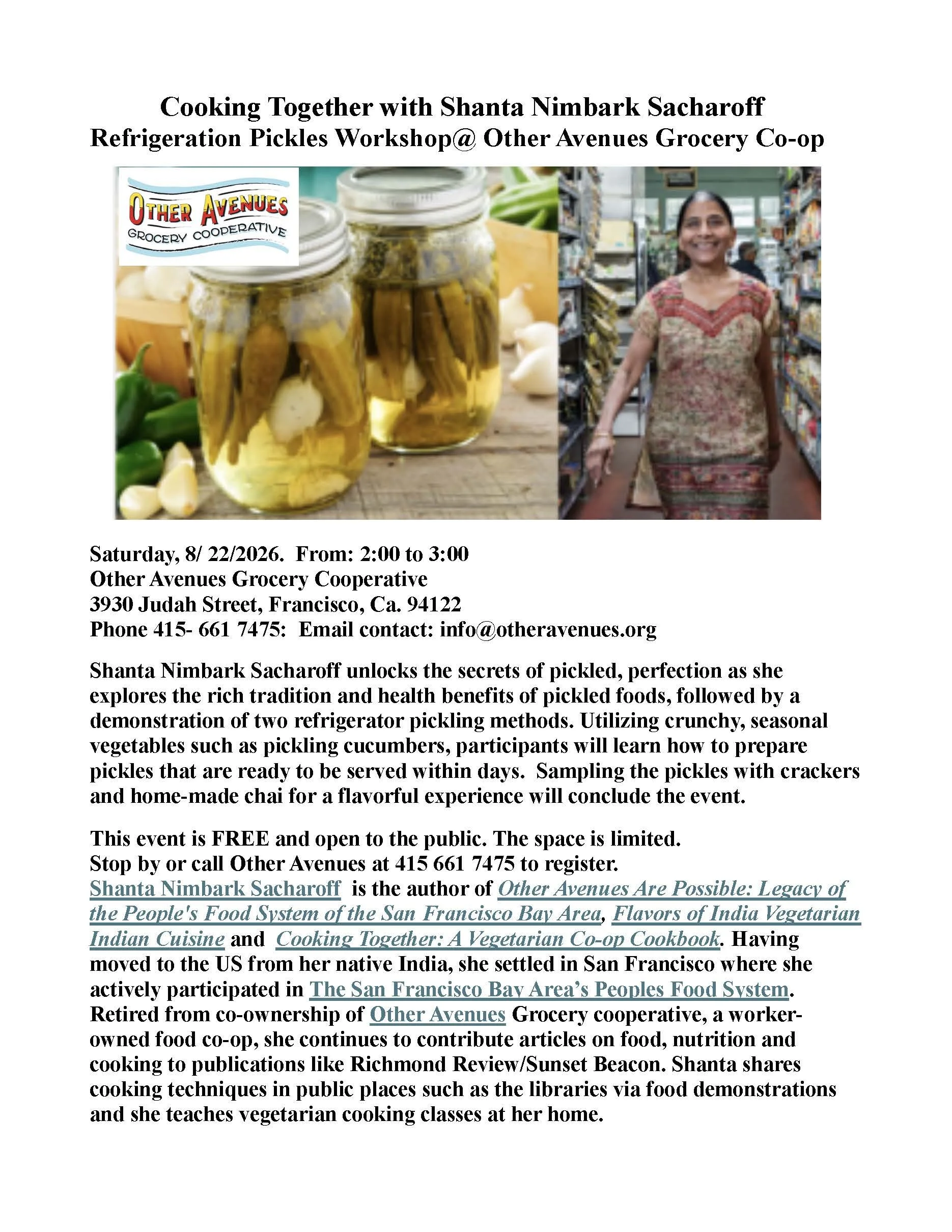
Making Refrigerator Pickles at Other Avenues with Shanta
Shanta Nimbark Sacharoff unlocks the secrets of pickled, perfection as she explores the rich tradition and health benefits of pickled foods, followed by a demonstration of two refrigerator pickling methods. Utilizing crunchy, seasonal vegetables such as pickling cucumbers, participants will learn how to prepare pickles that are ready to be served within days. Sampling the pickles with crackers and home-made chai for a flavorful experience will conclude the event.
This event is FREE and open to the public. The space is limited.
Stop by or call Other Avenues at 415 661 7475 to register.
Shanta Nimbark Sacharoff is the author of Other Avenues Are Possible: Legacy of the People's Food System of the San Francisco Bay Area, Flavors of India Vegetarian Indian Cuisine and Cooking Together: A Vegetarian Co-op Cookbook. Having moved to the US from her native India, she settled in San Francisco where she actively participated in The San Francisco Bay Area’s Peoples Food System. Retired from co-ownership of Other Avenues Grocery cooperative, a worker-owned food co-op, she continues to contribute articles on food, nutrition and cooking to publications like Richmond Review/Sunset Beacon. Shanta shares cooking techniques in public places such as the libraries via food demonstrations and she teaches vegetarian cooking classes at her home.
Public Charge and the Federal Nutrition Programs: What We Know So Far External Inbox
Public Charge and the Federal Nutrition Programs: What We Know So Far
Thursday, August 20, 2026, 3:00 p.m. Eastern (2:00 p.m. Central, 1:00 p.m. Mountain, 12:00 p.m. Pacific)
The Department of Homeland Security (DHS) recently released a new public charge rule that is likely to increase fear and uncertainty among immigrant and mixed-status families accessing the federal nutrition programs. This webinar will explain public charge, what the new rule says so far, and what questions still remain.
The 5 Conditions that Help Community-Led Councils Reclaim Their Stories and Activate Their Impact
Join CSPI on Wednesday, August 19th from 12:00 - 1:00 PM ET for an engaged presentation and discussion on The 5 Conditions that Help Community-Led Councils Reclaim Their Stories and Activate Their Impact.
What does it take for someone to use what they’ve lived through to change the systems that shaped it? In Arizona, nine community members with the shared experience of food insecurity answered that question together. Over six sessions, the Arizona Food Bank Network Food Justice Leadership Series used restorative circle practices and the Your Story, Your Terms™ storytelling framework to turn a room of strangers into community advisory advocates who understand how food policy works, know exactly who they are and what they're fighting for, and tell their stories with dignity and confidence.
Project co-leads Frank Velásquez Jr. of 4 Da Hood and Hawwa Muhammad of Pink Trumpet will discuss their unique approach and share how the series unfolded, what the evaluation found, and what they'd strengthen next time.
Expect to experience a "taste" of what participants experienced.
Este seminario virtual será en inglés y lo ofreceremos con interpretación y traducción al español en tiempo real.
Speaker Information:
Frank Velásquez Jr. (he/his/él), relentlessly pursues racial and gender equity, while creatively connecting our stories, preserving the unique flavor of each one like in a yummy bowl of jambalaya. As Founder of 4 Da Hood, he’s forging paths for communities of color to lead with more authenticity, courage, and joy, and build their generational wealth. Frank holds a Master’s degree in Human Relations from Northern Arizona University.
Hawwa Muhammad (she/hers), is the Founder of Pink Trumpet and supports mission-driven organizations through evaluation, project management, and learning design. She holds a Master’s degree in Public Administration from Rutgers University and is based in Newark, NJ.
This event is hosted as a part of CSPI’s Resource Hub Training Series. We invite organizations and community advocates to join us, as we at CSPI learn alongside our partners and community at large to build power and share knowledge across disciplines on a myriad of social, economic, and environmental justice issues.
Este seminario virtual será en inglés y lo ofreceremos con interpretación y traducción al español en tiempo real.
From 1996 to H.R. 1: 30 Years of Fighting for SNAP
From 1996 to H.R. 1: 30 Years of Fighting for SNAP
Monday, August 17, 2026, 2:00 p.m. Eastern (1:00 p.m. Central, 12:00 p.m. Mountain, 11:00 a.m. Pacific)
Thirty years ago, the Personal Responsibility and Work Opportunity Reconciliation Act fundamentally reshaped the nation’s economic mobility programs, leaving restrictions that continue to limit access to SNAP today.
Join Congressman Jim McGovern (MA-D2), and state poverty experts for a conversation about 30 years of harm, hard-won progress, and lessons for today’s fight.
We’ll examine SNAP cuts and their human and administrative costs, the advocacy that has chipped away at some harmful policies, and why those lessons matter as H.R. 1 expands time limits, restricts eligibility, and shifts unprecedented SNAP costs to states.
We cannot allow H.R. 1 to become the new normal—and spend the next 30 years trying to undo it.
Join us to reflect on where we’ve been and, most importantly, organize for what comes next.
Alemany Farmers Market Celebration
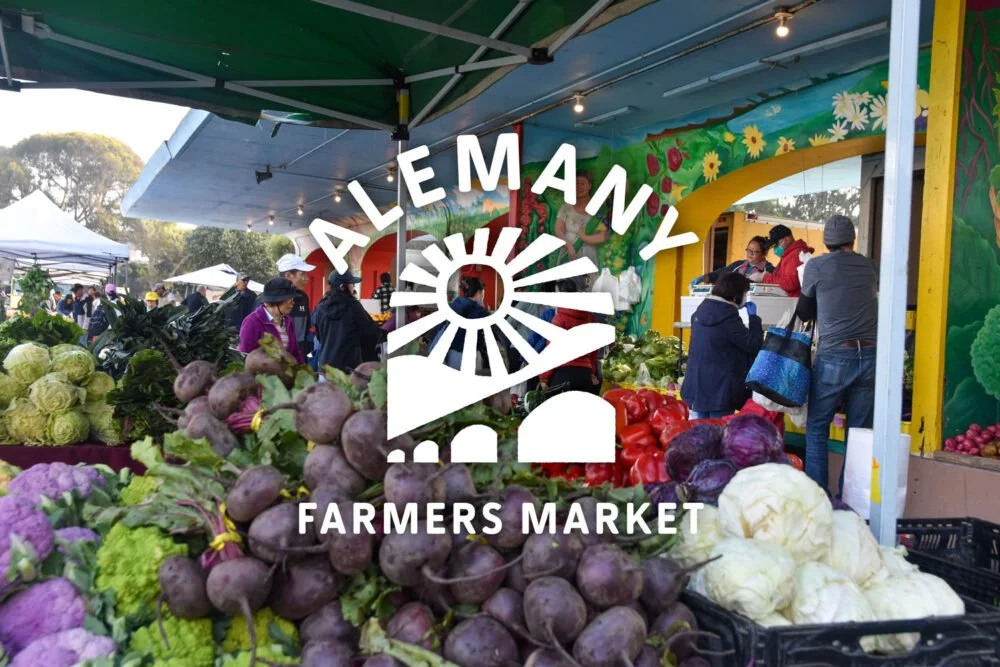
This National Farmers Market Week, please join Foodwise in celebrating Alemany Farmers Market, the market that started it all, on Saturday, August 8, 9 am to 12 pm. Join us for:
Welcome remarks (9:30 am)
Pick up a free Alemany Farmers Market tote bag and other goodies (while supplies last)
Tastings, family fun, music, and more!
Affectionately known as “The People’s Market,” the Alemany Farmers Market is the oldest continuously operated farmers market in California. First established on August 12, 1943, it played a key role in starting the farmers market movement in the state. Earlier this year, Foodwise was honored to become the manager of this beloved market, in partnership with the City and County of San Francisco.
With a focus on local food, affordability, and accessibility, the market hosts a diverse community of more than 80 small family farms and food businesses. Visit Alemany Farmers Market on Saturdays, 7 am to 2 pm, at 100 Alemany Boulevard in San Francisco’s Bernal Heights neighborhood, year round, rain or shine.

The ACS is a Human Needs Data Goldmine: What Human Needs Advocates Need to Know
Do you know what the American Community Survey (ACS) is and why it’s such a valuable and necessary resource in advocating for human needs? Do you know how you can use it to support your work?
Whether it’s access to SNAP and WIC, eligibility for health insurance, or the need for more subsidized housing, we use ACS data every day—and you can, too! (And you may already be using it even if you don’t realize it!)
We invite you to register for The ACS Is a Human Needs Data Goldmine, a webinar on Wednesday August 5, at 12 pm ET (9 am PT). Register here
ACS data is critical for advocacy for human needs programs. You can use it to show policymakers how programs will benefit their constituents; understand how federal funding is allocated for many human needs programs; assess how different racial and ethnic groups are being served; and create a baseline to measure whether programs are adequate for need. And the ACS data is available in tables at data.census.gov, so you don’t need to be a statistician to find what you need!
Our expert panelists will explain all of this and more:
Chris Becker, Vice President, Budget Policy and Data Analytics, First Focus on Children
Professor Iheoma U. Iruka, Department of Public Policy, University of North Carolina at Chapel Hill
Mark Mather, Associate Vice President of Programs, Population Reference Bureau
Jie Zong, Senior Research Analyst, UCLA Latino Policy and Politics Institute
Every human needs advocate should know what the ACS provides and how to use it. We hope you will register here and join us. As always, all registrants will be sent the recording, slides, and other materials.
One Year After H.R. 1: What Has Changed for Families, States, and Communities
One Year After H.R. 1: What Has Changed for Families, States, and Communities
Thursday, July 29, 2026, 3:00 p.m. Eastern (2:00 p.m. Central, 1:00 p.m. Mountain, 12:00 p.m. Pacific)
One year after the enactment of H.R. 1, communities across the country are experiencing the effects of sweeping changes to SNAP, Medicaid, and other economic mobility programs. As implementation has unfolded, new data and on-the-ground experience are beginning to paint a clearer picture of how these policy changes have affected families, state and local governments, healthcare systems, and local economies.
Join FRAC, Caring Across Generations, Americans for Tax Fairness, and the Hope Center for the release of a new cross-sector report examining the first year of H.R. 1 and what the evidence tells us about its impacts.
Whether you are a policymaker, state or local official, healthcare leader, advocate, researcher, or community partner, this webinar will provide an evidence-based look at the first year of H.R. 1 and its implications for communities across the country.
CalFresh Work and Community Engagement Activities Guest Speaker Webinar Series: California Community Colleges Chancellor’s Office (CCCCO) Part 2
CalFresh Work and Community Engagement Activities Guest Speaker Webinar Series: California Community Colleges Chancellor’s Office (CCCCO) Part 2
The California Community Colleges Chancellor's Office will join CDSS for a follow-up webinar exploring colocation models and their benefits—covering how on-campus co-located services boost student access to public benefits, streamline verification and referral, strengthen campus-community partnerships, and improve outcomes through coordinated supports.
To request a reasonable accommodation (such as language interpretation), please contact Juliana Utiyama at juliana.utiyama@dss.ca.gov by Friday, June 26, 2026. We will do our best to meet all requests received by this deadline.
SNAP Time Limits and the Volunteer Provision: Can Volunteer Opportunities Help Eligible Individuals Maintain SNAP Benefits?
SNAP Time Limits and the Volunteer Provision: Can Volunteer Opportunities Help Eligible Individuals Maintain SNAP Benefits?
Monday, July 27, 2026, 2:00 p.m. Eastern (1:00 p.m. Central, 12:00 p.m. Mountain, 11:00 a.m. Pacific)
As states expand SNAP time limits due to H.R. 1, agencies and partners are working to help eligible individuals understand their options and access food assistance. One federal tool is the SNAP Volunteer Provision, which allows qualifying volunteer service to satisfy time limits. But how is this working in practice? What lessons have been learned? What challenges and promising practices are emerging?
Join a solutions-focused webinar to explore the role of the volunteer provision for SNAP participants, agencies, community organizations, and volunteers nationwide. Participants will get a national overview of SNAP time limits, a 50-state view of volunteer opportunities, and insights from leaders implementing these policies. Speakers include a state SNAP agency sharing its experience, a community organization discussing developing volunteer opportunities and challenges, AARP on older adults affected by expanded limits and community support, and national policy experts highlighting trends, innovations, and best practices.
Whether you are a state administrator, community organization, volunteer provider, advocate, or policy professional, this webinar will provide practical strategies, lessons learned, and opportunities to strengthen partnerships that support eligible SNAP participants.
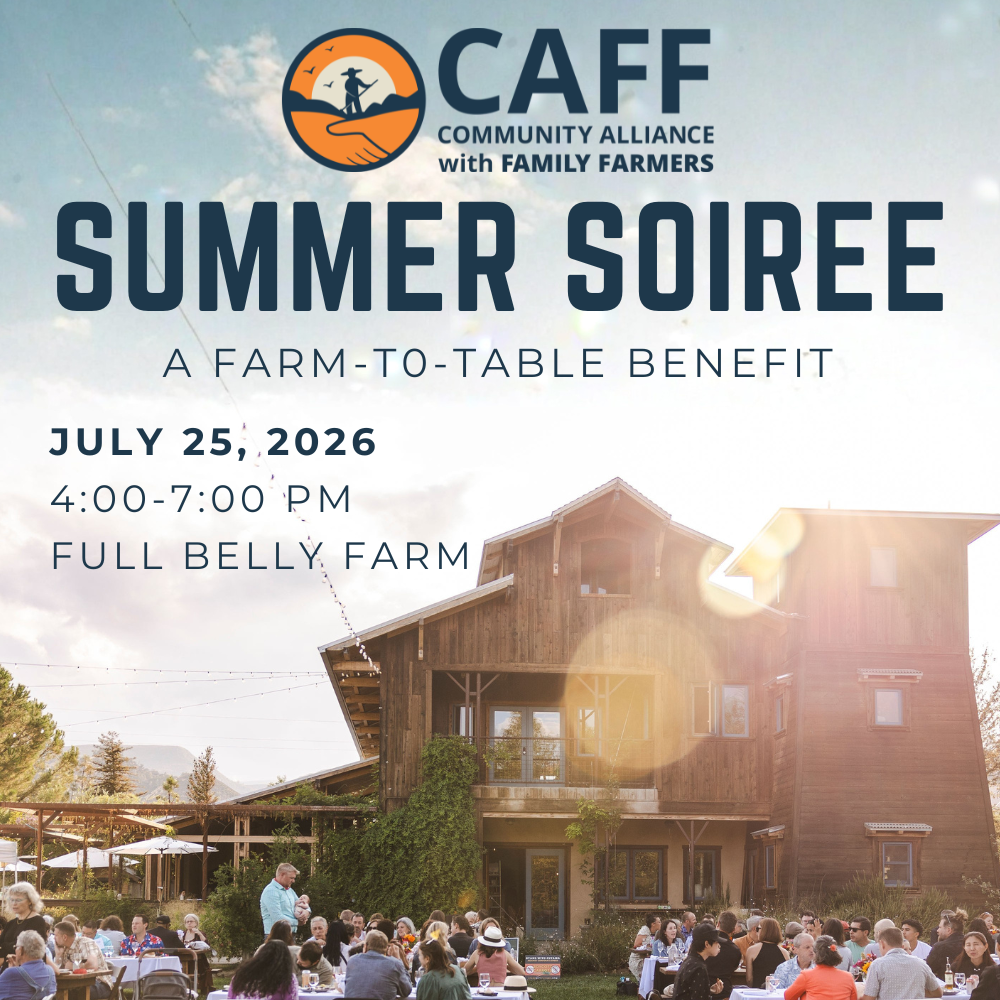
CAFF's Summer Soiree
Summer is here, and so is one of our favorite evenings of the year.
CAFF's Summer Soiree returns on July 25, 2026. And this year, we're celebrating in a big way.
Nestled in the heart of the Capay Valley, Full Belly Farm will be our backdrop for a farm-to-table benefit dinner honoring the women at the center of California's food and farming systems. The United Nations has declared 2026 the International Year of the Woman Farmer, and we're bringing that recognition to life under the open sky.
Expect a beautiful summer evening filled with:
Farm-fresh food sourced from local family farms and ranches
Wine, beer and seasonal libations
Live music from women artists
Inspiring words from women leaders in agriculture
Every ticket purchased is a direct investment in CAFF's advocacy and programs supporting women-led farms across California–and all family farms–work that has never mattered more than it does now.
Seats are limited.